GREEN ENERGY TRANSITION : What, So What, and What Now?
Energy security, climate commitments, and industrial competitiveness are driving the global green energy transition. Countries are reassessing how they produce and secure energy while still dealing with the long-term impacts of COVID-19, the war in Ukraine, and more recent geopolitical tensions, including conflict involving Iran. These events have intensified the push to reduce dependence on fossil fuels and strengthen domestic energy resilience.
Clean energy finance is increasingly moving toward renewable production, with the European Union and China leading major efforts. For countries with limited fossil fuel reserves, renewable energy is both a strategic economic shift and a way to meet climate commitments under the Paris Agreement and Nationally Determined Contributions. The European Union recently funded 63 million euros for wind farms in France, which are expected to reach up to 11.1 GW of combined capacity and generate up to 47.8 TWh of renewable electricity per year, equal to about 10.6% of France’s annual electricity consumption. France targets 2030 Coal Exit and halves carbon emissions by 2030.
China is another major leader in the transition after EU region. Reuters has reported that China aims for renewable energy to meet 50% of the country’s energy needs by 2030. The World Economic Forum has also highlighted China’s long-term pursuit of domestic electrification and scalable energy systems, which may provide resilience during supply shocks such as disruptions around the Strait of Hormuz.
So What?
Renewable energy is becoming more important at both macro and micro scales. At the national level, governments are investing in solar, hydro, and wind because these technologies can often expand faster than nuclear power, which requires more infrastructure, planning, and long project timelines. At the household level, stronger and more erratic weather events are increasing the need for localized energy security, even in developed nations.
Around one seventh of global primary energy production is sourced from renewable technologies, while solar and wind have grown rapidly in recent years.
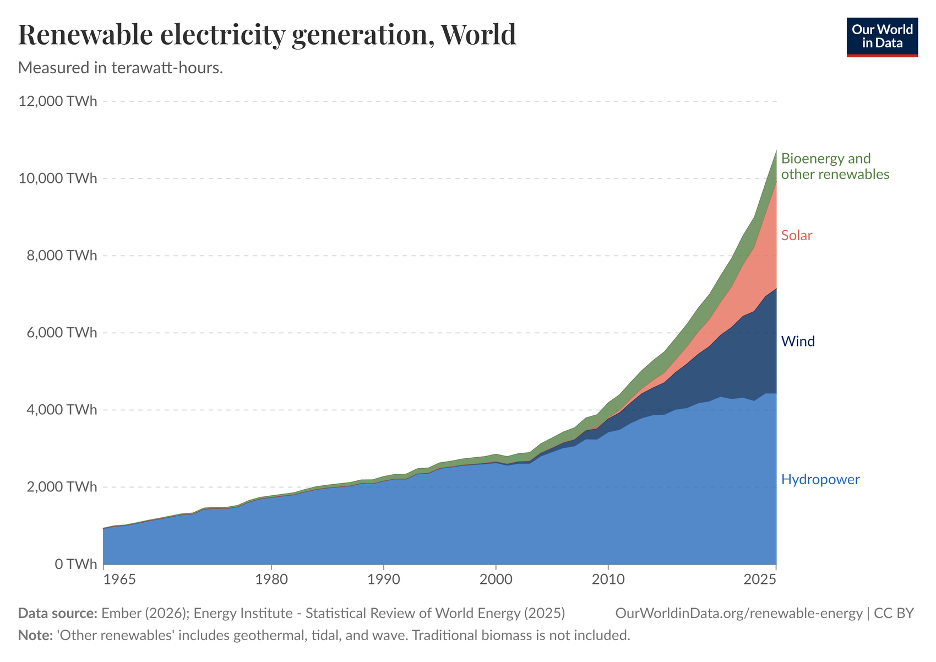
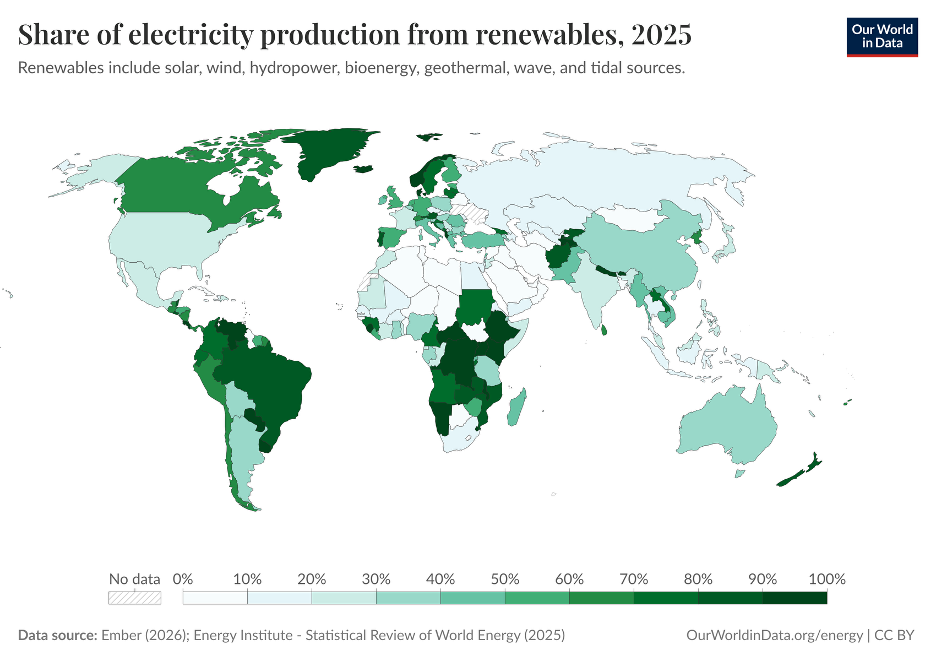
Renewables represent a much larger share of electricity generation than of total energy use. Around two thirds of renewable energy use is tied to electricity, while transport and heating remain harder to decarbonize because they rely more heavily on oil and gas.
What Now?
Scope 1 and Scope 2 emissions will be a major focus for companies and governments seeking to reduce greenhouse gas emissions through renewable energy. Replacing fossil-fuel-based electricity with clean power can lower direct and purchased-energy emissions, but deeper decarbonization will require investment across transport, heating, industry, and grid infrastructure.
Future energy demand is also expected to rise, especially because of data centers and digital infrastructure. While the national impact of data centers may appear limited, regional effects on electricity demand, grid capacity, and clean energy planning could be significant. The next stage of the green energy transition should therefore combine renewable investment with grid modernization, storage, demand management, and targeted policies for high-growth energy users.